

 Comptes Rendus Palevol
25 (20) - Pages 375-389
Comptes Rendus Palevol
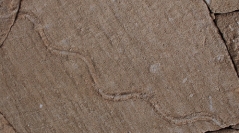
25 (20) - Pages 375-389Pleistocene well-sorted bioclastic calcarenites form an aeolian sand-sheet in south-western Maio Island (Cabo Verde Archipelago) that contains distinctive, large, horizontal, sinuous trace fossils attributed to the ichnogenus Cochlichnus Hitchcock, 1858. Owing to its size and morphology, this trace is described herein as a new ichnospecies, Cochlichnus grandis isp. nov. Morphometric parameters, the sedimentary context, and comparison with modern analogues indicate that the trace was most likely produced by a sand-swimming skink lizard, which was partially buried at the surface or fully subsurface within the sand. To date, traces produced by skinks swimming through loose sand have not been documented in the fossil record even if they have been studied thanks to neoichnological experiments. Preservation of C. grandis isp. nov. was facilitated by relatively high substrate moisture in a coastal aeolian setting and by early carbonate cementation – conditions that are rarely met in dry siliciclastic dune systems. This narrow taphonomic window explains the exceptional rarity of fossil traces recording sand-swimming behaviour, despite the wide distribution and long evolutionary history of skinks in arid and semi-arid regions.
Ichnology, ichnotaxonomy, fossil behaviour, aeolianites, West Africa, new ichnospecies