

 Comptes Rendus Palevol
25 (18) - Pages 319-356
Comptes Rendus Palevol
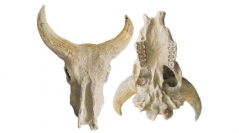
25 (18) - Pages 319-356Variation in the timing and rate of development (heterochrony) is a key driver of morphological diversification. The African buffalo (Syncerus caffer (Sparrman, 1779)) is the sole surviving species of a once diverse Pleistocene clade and shows striking eco-morphological variability that may be the result of heterochronic shifts. Heterochrony has also been suspected to account for the past diversity of Syncerus, but the early evolution of this clade has remained obscure due to limited fossil evidence. Here we describe new material from the Shungura Formation (southern Ethiopia), including a nearly complete cranium dated to c. 2.6 Ma, which we designate as the type of a new species of Syncerus Hodgson, 1847. This species is small-bodied with short, divergent horns, resembling immature and small-bodied extant Sy. caffer (forest or “nanus” ecomorphs). Three-dimensional geometric morphometrics reveal that fossils of Ugandax Cooke & Coryndon, 1970 and Syncerus (including the new cranium) broadly follow the ontogenetic size-shape allometry of Sy. caffer, suggesting cranial diversification along a conserved allometric trajectory, and that the new species may represent an ancestral form from which later Syncerus evolved. In contrast, the extreme horn length of the extinct giant buffalo Sy. antiquus (Duvernoy, 1851) departs from this pattern, indicating lineage-specific innovation. These findings provide the earliest well-preserved evidence of the African buffalo lineage and highlight the role of conserved allometry and heterochrony in the evolutionary history of Syncerus. They also underscore the importance of new fossil discoveries and comparative analyses for understanding the origins of morphological diversity.
This article has undergone a dual peer-review, initially by PCI Paleontology (recommendation https://doi.org/10.24072/pci.paleo.100399), and subsequently by the Comptes Rendus Palevol.
Syncerus, Bovidae, Pliocene, Pleistocene, Africa, geometric morphometrics, heterochrony, new species