


 Comptes Rendus Palevol
25 (16) - Pages 273-305
Comptes Rendus Palevol
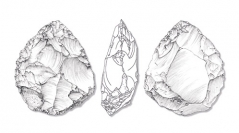
25 (16) - Pages 273-305Valle Giumentina (Abruzzo, Italy) comprises 12 archaeological levels dating from MIS 15 to MIS 12, four of which contain bifacial industries. Level SLM-37, excavated between 2015 and 2017 in two areas, reflects a steppic environment and is attributed to MIS 12c. It yielded a bifacial industry made on local cherts (1 471 artefacts, including one biface). Post-depositional modifications only slightly affected the assemblage, and numerous refits were identified. Faunal remains are scarce (Cervus elaphus Linnaeus, 1758 and possibly Dama dama (Linnaeus, 1758)). Flaking activities occurred at the site, which appears to have been occupied briefly but repeatedly. A shift in biface structure is observed between level SLM-37 and the subsequent MIS 12b level LABM-40, from “biface as a blank for tools” to “biface as a tool.” This structural change coincides with the emergence of core-and-flake production, absent in SLM-37. Valle Giumentina is one of the very few sites associated with the glacial event of MIS 12. The feasibility of detailed and reliable chronostratigraphic and palaeoenvironmental reconstructions for the Middle Pleistocene is demonstrated here. This allows us to identify a previously unknown, local, and rapid evolution of bifacial industries, and to propose multiple reinventions and developments of the biface within the European Lower Palaeolithic. Notably, owing to the exceptional state of preservation of the site, the LABM-40 biface exhibits some of the earliest identified use-wear traces on a biface until now.
Lower Palaeolithic, biface, Middle Pleistocene, lithic technology, techno-economy, traceology, palaeoenvironments, Europe, Valle Giumentina, Acheulian, micromorphology, taphonomy