


 European Journal of Taxonomy
1084 (1) - Pages 1-71
European Journal of Taxonomy
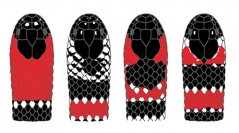
1084 (1) - Pages 1-71Coralsnakes of the genus Micrurus Wagler, 1824 contain approximately 89 species distributed from the United States to Argentina. The genus Micrurus comprises numerous species and presents important taxonomic challenges, particularly in lineages where morphological similarity among species complicates species delimitation. Many species have been described based on subtle morphological differences and/or inadequate molecular analyses. In this study, we focused on cis-Andean monadal coralsnakes using an integrative taxonomic approach that combines a multilocus dataset of mitochondrial (mtDNA) and nuclear (nDNA) gene fragments with morphological data, ecological niche models (ENMs), and extent of occurrence (EOO) analyses to assess species boundaries and infer phylogenetic relationships. Maximum Likelihood and Bayesian phylogenies revealed discrepancies between morphology-based taxonomy and molecular data. Among our findings, we support the junior synonymization of M. petersi Roze, 1967, M. peruvianus Schmidt, 1936, M. steindachneri (Werner, 1901), and M. tikuna Feitosa, Da Silva Jr., Pires, Zaher & Prudente, 2015, with M. ornatissimus (Jan, 1858), and of M. albicinctus Amaral, 1926, M. annellatus annellatus (Peters, 1871), M. a. balzani (Boulenger, 1898), and M. bolivianus Roze, 1967, with M. corallinus (Merrem, 1820). In contrast, our results confirm the distinctiveness of M. langsdorffi (Wagler, 1824) and M. medemi Roze, 1967 as separate evolutionary lineages, warranting their recognition as valid species. Multivariate analyses of morphometric traits showed limited differentiation among the three focal species in both sexes. Discriminant analysis of localities in environmental niche space showed an overall classification accuracy of 92.2%. The distributions of M. langsdorffi and M. ornatissimus broadly overlap, indicating sympatry, whereas both species are allopatric with respect to M. corallinus. Both occur between the Amazon and Negro rivers, whereas M. corallinus is distributed south of the Amazon River, with an isolated population in the Brazilian Atlantic Forest. These disjunctions are consistent with Wallace’s Riverine Barrier Hypothesis, suggesting river systems as major isolating factors. Micrurus medemi occurs along the eastern Andean foothills of Colombia. These results indicate that past morphology-based and/or organellar DNA-based taxonomic studies have overestimated species diversity. Our study highlights the importance of integrative taxonomy for accurately delimiting species and improving our understanding of the evolutionary history of monadal coralsnakes.