

 Comptes Rendus Palevol
25 (11) - Pages 189-205
Comptes Rendus Palevol
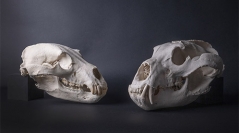
25 (11) - Pages 189-205Little is known about the European Pleistocene brown bear Ursus arctos Linnaeus, 1758. To assess its ecological adaptations, the mandibular morphology of fossil U. arctos was analysed using 3D geometric morphometrics and compared to that of closely related Ursini. Landmarks for 3D digitisation of the mandible were chosen to reflect functional morphology relating to the musculus masseter. Extant and extinct Pleistocene Ursini of the species U. deningeri Reichenau, 1904, U. spelaeus Rosenmüller, 1794, U. arctos and U. maritimus Phipps, 1774 were digitised or surface scanned. Generalised Procrustes superimposition was performed on the coordinates and allometry corrected for using a regression analysis pooled by species. Principal component analysis (PCA), canonical variate analysis (CVA), and a multivariate analysis of variance (MANOVA) were performed. PCA and CVA differentiate between species and subspecies in extant Ursini. Fossil U. arctos is similar to the extant Eurasian brown bear (U. a. arctos). The mandibular morphology of fossil brown bears from cold periods displays similarities to extant bears living in high latitude and high altitude environments, whereas the mandibular morphology of fossil brown bears from warm periods is significantly different to those from cold periods regardless of geological age. The masticatory differences between warm and cold adapted fossil brown bears, found in the present study, indicate that evolutionary flexibility may have played an important role in the survival of brown bears into the Holocene.
Ursus arctos, Ursidae, ursids, Pleistocene, geometric morphometrics, palaeobiology, palaeontology